
Why Filter Media Selection Determines Baghouse Performance
1.In heavy industrial operations—such as coal-fired boilers, cement kilns, electric arc furnaces (EAF), blast furnaces, and chemical synthesis plants—the reliability of pulse-jet baghouse dust collectors depends largely on the installed filter bags.
Procurement teams frequently encounter issues such as premature bag failure, high differential pressure (ΔP > 1500 Pa), or sudden filter media blinding (blinding/caking). While these problems are often attributed to "poor bag quality," on-site diagnostics reveal that over 80% of filtration failures stem from a mismatch between the filter media and actual operating conditions. Fluctuations in flue gas temperature, trace moisture condensation (H₂O), sulfur oxides (SOx), nitrogen oxides (NOx), hydrofluoric acid (HF), or abrasive sparks can cause the degradation of conventional fiber properties in just a few weeks.
With twenty years of experience in the industrial filtration sector, Luoyang Xinlian Environmental Protection Technology Co., Ltd. (XINLIAN) understands that efficient dust removal requires a comprehensive, systematic approach: designing suitable fiber chemical compositions, employing appropriate heat and surface treatments, and precisely matching filter bags with precision-manufactured cages and pulse-jet airflow parameters.
This engineering guide provides an in-depth analysis of filter bag materials for ambient and high-temperature applications, a comparison of technical specifications, and practical selection methods for extreme industrial operating conditions.
2.Core Filter Bag Materials: Chemical Properties, Temperature, and Operational Limits
Industrial filtration materials are classified based on criteria such as fiber polymer chemistry, continuous and peak operating temperatures, tensile strength, and resistance to acid/alkali hydrolysis. The following are the primary materials commonly used in modern industrial baghouse dust collectors:
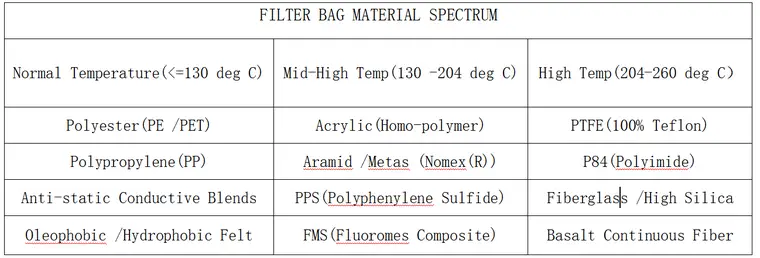
2.1 Polyester (PE / PET Needle Felt) — The Workhorse of Industrial Applications
Continuous operating temperature: 120°C (248°F)
Peak/instantaneous temperature: 130°C – 150°C
Chemical properties: Excellent abrasion resistance and high dry tensile strength; fair resistance to weak acids; poor resistance to hot, humid hydrolysis at high temperatures; susceptible to attack by concentrated alkalis.
Main applications: Cement raw meal grinding, aggregate processing, wood processing, grain conveying and handling, metal manufacturing, and general collection of dry dust at ambient temperatures.
Surface treatments: ePTFE microporous membrane lamination, anti-static (metal/carbon fiber) treatment, singeing, and calendering.
2.2 Polypropylene (PP) — A Material with Excellent Chemical Resistance for Humid and Ambient-Temperature Gases
Continuous operating temperature: 90°C (194°F)
Peak temperature: 100°C
Chemical properties: Excellent resistance to both strong acids and strong alkalis; hydrophobic properties prevent filter media blinding (bag blinding) caused by sticky or moist dust.
Main applications: Chemical crystallization, pharmaceutical powder recovery, electroplating exhaust treatment, wastewater treatment exhaust emissions, and battery manufacturing drying processes.
2.3 Acrylic (Homopolymer Polyacrylonitrile / Dralon-T) — An Ideal Hydrolysis-Resistant Alternative
Continuous operating temperature: 125°C – 130°C (257°F – 266°F)
Peak temperature: 140°C
Chemical properties: Significantly better performance than polyester in humid, acidic environments; offers good hydrolysis resistance in operating conditions where boiler exhaust temperatures fall within the transition range between ambient and high temperatures.
Main applications: Waste drying plants, lime slaking processes, auxiliary dust removal systems for non-ferrous metal smelting, and medium-temperature biomass drying equipment. 2.4 PPS (Polyphenylene Sulfide / Ryton®) — The standard choice for acid-resistant boiler applications
Continuous operating temperature: 160°C – 190°C (320°F – 374°F)
Peak temperature: 200°C
Chemical properties: Excellent resistance to strong acids (SO2, SO3, HCl) and sulfur-rich flue gas; moderate alkali resistance. Key operational limitation: Highly sensitive to oxidative degradation (oxygen content >8–10%) at temperatures exceeding 165°C.
Primary applications: Coal-fired thermal power plants, municipal utility boilers, biomass co-firing boilers, and carbon black production.
XINLIAN Optimized Solution: Uses a PPS/PTFE blended needle-punched felt; this protects vulnerable PPS fibers from premature oxidation while maintaining good mechanical flexibility and structural integrity.
2.5 Aramid / Metas (Nomex® type) — Thermally stable material for dry, non-acidic flue gas environments
Continuous operating temperature: 180°C – 204°C (356°F – 400°F)
Peak temperature: 220°C
Chemical properties: Excellent flame retardancy and spark resistance; long flex-fatigue life and high dimensional stability. Key weaknesses: Sensitive to hydrolysis (moisture) and acidic vapors (SOx); the material degrades rapidly in acidic gas environments if the dew point is reached.
Primary applications: Hot-mix asphalt plants, electric arc furnace (EAF) flue gas capture, foundry cupola furnaces, and refractory drying kilns. 2.6 P84® (Polyimide / PI) — Multilobal fibers with high specific surface area
Continuous operating temperature: 240°C (464°F)
Peak temperature: 260°C
Chemical properties: Non-flammable polyimide fiber featuring a unique "cloverleaf" (trilobal) cross-sectional structure. This morphology increases the specific surface area by 80% compared to round fibers, thereby providing superior filtration efficiency for sub-micron particles (PM2.5/PM1.0) without causing excessive pressure drop.
Key applications: Cement clinker kiln outlets, lime kilns, hazardous waste incinerators, and iron and steel sintering dust removal systems.
2.7 100% PTFE (Polytetrafluoroethylene / Teflon®) — The ultimate chemical and thermal barrier
Continuous operating temperature: 250°C (482°F)
Peak temperature: 260°C – 280°C
Chemical properties: Absolutely chemically inert across the entire pH range (0–14); zero moisture absorption; lowest coefficient of friction among engineering polymers, preventing filter media clogging ("bag blinding") caused by sticky or hygroscopic dust.
Key applications: Hazardous waste incineration, coal-chemical synthesis, municipal solid waste-to-energy (WtE) plants, and flue gas streams containing high concentrations of corrosive HF, HCl, and heavy metal vapors.
2.8 Woven fiberglass and high-silica modified felt — Exceptional thermal stability
Continuous operating temperature: 260°C (500°F)
Peak temperature: 280°C – 300°C
Chemical properties: Extremely high tensile strength; near-zero elongation; non-flammable. Susceptible to mechanical flex fatigue unless treated with silicone oil, graphite, or PTFE coatings, or laminated with an expanded microporous ePTFE membrane. Key applications: Secondary metallurgy, dry-process blast furnace gas cleaning, glass melting furnaces, and cement preheater towers.
2.9 Basalt fiber needle-punched felt — A natural, high-temperature resistant alternative to silicate materials
Continuous operating temperature: 240°C – 260°C
Key features: Produced by drawing volcanic basalt; eco-friendly and harmless; exhibits excellent resistance to radiation and sparks; and possesses higher tensile strength than standard fiberglass.
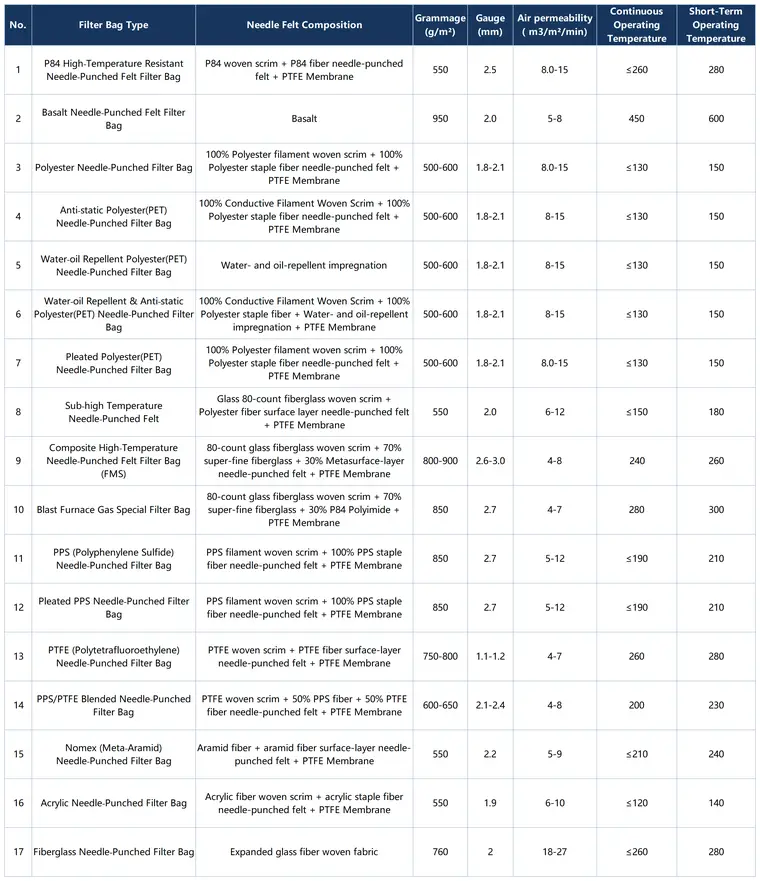
3.Engineering Specification Matrix: Material Comparison. To assist the engineering team in evaluating trade-offs regarding physical properties, the table below compares the key mechanical, thermal, and chemical characteristics of industrial filtration media:
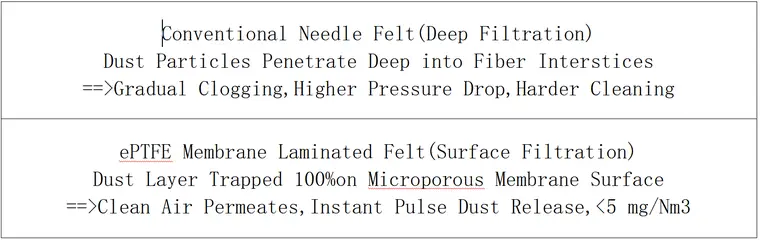
4.Advanced surface finishing and treatment technologies: Enabling the transition from depth filtration to surface filtration. The base needle-punched felt serves merely as a foundation; surface treatment processes allow for the control of dust cake formation, pressure drop, and cleaning efficiency:
Singeing and Calendering: The filter felt passes through high-speed gas flames to remove loose surface fibers, while heated rollers apply pressure to smooth the surface. This prevents dust adhesion and facilitates filter cake release.
PTFE Impregnation (Full Immersion Coating): Each fiber is fully immersed in a fluoropolymer solution, creating a complete protective coating that resists corrosion caused by acid dew condensation.
Water and Oil Repellent Treatment (Oleophobic/Hydrophobic Fluorocarbon Finish): Crucial for applications such as asphalt plants, cement plants, and aggregate processing; it prevents moisture and oily hydrocarbons from causing hygroscopic "mud-like caking."
Conductive/Anti-static Grounding (Conductive Fibers/Stainless Steel Fiber Mesh): Stainless steel wires or carbon fibers are woven into the base fabric, allowing for the safe dissipation of static charges in combustible dust environments (compliant with ATEX standards).
ePTFE Microporous Membrane Lamination: The benchmark for modern environmental compliance. An expanded polytetrafluoroethylene (ePTFE) membrane—featuring billions of sub-micron pores per square centimeter—is thermally laminated onto the base material, achieving:
True Surface Filtration: Particulates are intercepted at the outer surface of the filter medium (capture efficiency >99.99% for 0.1–1.0 μm particles).
Consistently Ultra-low Emissions: Reliably achieves emission levels below 5 mg/Nm³.
Compressed Air Energy Savings: Low surface energy properties allow the filter cake to detach instantly at lower pulse-jet pressures (0.2–0.3 MPa).
5.XINLIAN’s Advantages: Full Industrial Value Chain and Structural Synergy
Selecting the right filter medium is only half the battle. Even a high-performance filter bag can fail prematurely if paired with a substandard cage or installed in a dust collector chamber with uneven airflow distribution.
As an original manufacturer with full-chain capabilities, XINLIAN eliminates the interface compatibility risks often associated with third-party intermediaries:
5.1 Manufacturing Heritage Rooted in a State-Owned Enterprise
Established in 2008, Luoyang Xinlian Environmental Protection Technology Co., Ltd. was formed through the restructuring of the Jingwei Mangshan Glass Fiber Factory—formerly a subsidiary of the state-owned Luoyang Glass Group. We carry forward decades of deep technical expertise in the fields of metallurgy and silicate fibers. Today, we operate a modern 38,000-square-meter facility staffed by 158 skilled technical experts, with annual production capabilities including:
Over 2 million linear meters of needle-punched filter felt.
Production lines fully certified to ISO 9001:2015, ISO 14001:2015, and ISO 45001:2018 standards.
End-to-end quality control: raw fiber tensile strength testing → air permeability grading → automatic laser cutting → automatic multi-needle stitching → weld integrity inspection.
5.2 Precision Dust Collector Cages: Extending Filter Bag Service Life by 30%
Rough weld points and deformed longitudinal ribs on cages are primary causes of mechanical wear and pinhole leaks in filter bags. Xinlian manufactures compatible dust collector cages using multi-point CNC resistance welding lines:
Structural integrity: Available in circular configurations with 8, 10, 12, 16, or 24 longitudinal ribs and evenly spaced ring ribs, effectively preventing fatigue damage to the filter media caused by repeated flexing.
Anti-corrosion coatings: Options include heavy-duty galvanizing, silicone baking enamel (for continuous operation at 260°C in acidic gas environments), or electropolished 316L stainless steel.
Segmented quick-lock joints: Featuring patented twist-lock and claw-style connection structures, these facilitate filter bag installation in confined spaces without damaging the bag collar.
Pleated star-shaped cages: Specifically designed for pleated filter bag retrofitting projects, capable of maximizing filtration area by 200%–300%. 5.3 Complete Pulse-Jet Dust Removal Systems
In addition to consumables, XINLIAN designs and manufactures complete industrial baghouse dust removal systems:
Long-bag, low-pressure pulse dust collectors for 280-ton coal-fired boilers and cement kilns.
Flue gas capture systems specialized for blast furnace tapholes and non-ferrous metal smelting furnaces.
Auxiliary equipment: spark arrestors, rotary discharge valves, PLC pulse control cabinets, and acoustic diagnostic sensors.
6.Selection Guide: Material Matching for Demanding Operating Conditions
6.1 Cement Plants (Raw Meal Mills, Coal Mills, Clinker Coolers, and Kiln Inlets/Outlets)
Kiln Outlet Conditions: Temperatures of 200°C–250°C; high SOx/NOx concentrations; presence of abrasive, alkaline bypass dust.
Recommended Solution: XINLIAN P84® and woven fiberglass composite with ePTFE membrane, or 100% PTFE needle-felt paired with a silicone-coated 16-rib cage.
Coal Mills: High explosion risk → XINLIAN anti-static polyester/acrylic needle-felt (with conductive grid; resistance < 10⁶ Ω).
6.2 Coal-Fired Power Plants and Biomass Boilers
Operating Conditions: Combustion of coal with varying sulfur content; flue gas temperatures of 140°C–175°C; high moisture/humidity; risk of acid dew point corrosion during startup.
Recommended Solution: XINLIAN high-density PPS needle-felt or PPS/PTFE blend needle-felt with membrane lamination. Achieves sustained emission concentrations below 5 mg/Nm³ with an average service life exceeding 36 months. 6.3 Iron and Steel & Metallurgical Plants (Blast Furnaces, Electric Arc Furnaces, Sintering Processes)
Blast furnace tapholes and cast houses: High dust concentrations accompanied by intermittent high-temperature peaks and sharp iron oxide particles.
Recommended Solution: XINLIAN FMS composite filter media or spark-resistant Nomex® (aramid) filter media for medium-high temperatures, paired with a heavy-duty baghouse dust collector featuring an internal pre-settling baffle design.
6.4 Waste-to-Energy and Hazardous Waste Incineration
Operating Conditions: Highly corrosive mixed acidic gases (HCl, HF, SOx), trace amounts of dioxins and heavy metals, and significant temperature fluctuations (180°C–240°C).
Recommended Solution: XINLIAN 100% PTFE (polytetrafluoroethylene) needle-punched felt (with a composite hydrophobic ePTFE membrane), paired with 316L stainless steel or silicone oil-coated filter cages.
- Partner with the Original Manufacturer for Sustainable Air Purification Selecting the right filter bag material requires a comprehensive evaluation of thermodynamic properties, chemical resistance, dust release performance, and system-level aerodynamic requirements. Common, low-cost, off-the-shelf filter bags often lead to frequent production line downtime, environmental fines, and high labor costs for replacement. XINLIAN operates a 38,000-square-meter manufacturing facility, leveraging the deep technical expertise inherited from the Luoyang Glass Group and maintaining strategic partnerships with four national-level high-tech enterprises. We also maintain solid, trust-based relationships with industry leaders such as China National Building Material Group (CNBM), CITIC Heavy Industries, and Anyang Iron & Steel, dedicated to providing reliable, durable industrial air treatment solutions. Request a Customized Flue Gas Analysis and Engineering Quote Whether you need to replace failed filter bags, optimize pulse-jet cleaning performance, or plan an entirely new baghouse dust collection system, we are here to support you.