
As a factory owner or manager, you know that efficient operations are just as crucial as maintaining high product quality. A key factor in achieving these goals is ensuring your dust collection system runs efficiently; selecting the right filter bags can significantly reduce your facility's electricity costs.
With over 20 years of experience in industrial dust collection, Xinlian Environmental Protection has witnessed firsthand the impact filter bags have on energy consumption. In this article, we explore various filter bag materials and their advantages, and discuss how to choose the right ones to help you lower energy costs.
- Executive Overview: The Unseen Energy Drain in Industrial Dust Collection
In heavy continuous-process industries—such as cement manufacturing, coal-fired power plants, metallurgical smelters, waste-to-energy incineration, and chemical processing—facility executives continuously audit mechanical drive loads, ball mills, extruders, and furnaces to contain escalating energy costs.
Yet, one of the three largest electrical power consumers in the facility regularly operates unmonitored behind the main building: the industrial baghouse dust collection system.
A baghouse exerts an ongoing utility drain across two distinct operational systems:
- The Primary Induced Draft (ID) Exhaust Fan: Often powered by 150–800+ kW150–800+ kW motors running 24/7/365 to pull tens or hundreds of thousands of cubic meters per hour (m3/hm3/h) through the filter array.
- The Plant Compressed Air Installation: Demanding continuous high-pressure compressed air (0.3–0.7 MPa0.3–0.7 MPa) to fire pulse valves and dislodge dust cake from hundreds to thousands of filter tubes.
The mechanical connection linking these power drains directly to monthly operating expenses is a single physical parameter: Differential Pressure (ΔPΔP) across the filter media.
When an incorrect or generic filter fabric is chosen, particulate penetrates deep into the fiber matrix, triggering irreversible depth blinding. As airflow resistance climbs from a baseline 800 Pa800 Pa (3.2 in. w.g.3.2 in. w.g.) toward 1,800–2,400+ Pa1,800–2,400+ Pa (7.2–9.6+ in. w.g.7.2–9.6+ in. w.g.), the ID fan motor must dramatically increase amperage draw to maintain design ventilation velocity, while pulse valves fire at aggressive intervals, bleeding costly compressed air.
As a dedicated source equipment and media manufacturer with over 20 years of state-owned glass group engineering heritage, Luoyang Xinlian Environmental Protection Technology Co., Ltd. (XINLIAN) demonstrates that replacing generic depth-filtration felt with engineered surface-filtration media—paired with precision-aligned internal support cages—can reduce baghouse-driven power consumption by 15% to 35%, saving tens of thousands of dollars annually in industrial utility charges.
2. Thermodynamics & Fluid Dynamics: The Mathematics of Baghouse Power Consumption
To understand how filter fabric selection governs utility charges, facility managers must examine the governing fluid dynamics of centrifugal exhaust fans.
THE HIGH-RESISTANCE UTILITY EXPENSE SPIRAL
Standard Depth-Filtration Felt (Generic Uncoated Fabric) |
| ==> Fine particulate penetrates deep into the inner fiber matrix |
| ==> Incomplete cleaning produces irreversible fabric blinding & compacted dust cake |
| ==> System Differential Pressure surges (Delta P > 1,800 Pa)
+------------------------------------+------------------------------------+ |
| | | | |
| v v v |
[ ID Fan Motor Overload ] [ Excessive Pulse Frequency ] [Premature Bag Failure ]
Fan works harder against Delta P; Pulse timer drops to 5-10 sec cycles; Mechanical fatigue & VFD ramps to peak kW and amps; Compressor runs fully loaded 24/7; abrasive flex rupture; |
|Electric bill climbs exponentially. Air compression costs multiply. Frequent downtime & swaps.
2.1 The Fan Power Equation: Why ΔPΔP Multiplies Kilowatt-Hours
The electrical brake horsepower (BHPBHP) required by an industrial process fan is directly proportional to the total system pressure differential:
Power (kW)=Q×ΔP1000×ηfan×ηmotorPower (kW)=Q×ΔP /1000×ηfan×ηmotor
Where:
- QQ = Volumetric airflow rate (m3/sm3/s)
- ΔPΔP = Total system static pressure differential (PaPa)
- ηfanηfan = Fan mechanical/aerodynamic efficiency (typically 0.65–0.750.65–0.75)
- ηmotorηmotor = Motor electrical efficiency (typically 0.90–0.950.90–0.95)
Real-World Operating Calculation: Consider an industrial baghouse exhausting 120,000 m3/h120,000 m3/h (33.33 m3/s33.33 m3/s) running continuously for 8,0008,000 operating hours per year:
- Baseline Scenario (Blinded Standard Media): Operating at ΔP=2,000 PaΔP=2,000 Pa
Power=33.33×2000/1000×0.70×0.92≈103.5 kW
Annual Electricity Used=103.5 kW×8,000 hrs=828,000 kWhAnnual Electricity Used=103.5 kW×8,000 hrs=828,000 kWh
- Optimized Scenario (XINLIAN ePTFE Surface Filtration): Operating at ΔP=1,100 PaΔP=1,100 Pa
Power=33.33×1100/1000×0.70×0.92≈56.9 kWPower=1000×0.70×0.9233.33×1100≈56.9 kW
Annual Electricity Used=56.9 kW×8,000 hrs=455,200 kWhAnnual Electricity Used=56.9 kW×8,000 hrs=455,200 kWh
Net Annual Electricity Savings=828,000−455,200=372,800 kWhNet Annual Electricity Savings=828,000−455,200=372,800 kWh
At a standard industrial rate of $0.10 per kWh, engineering the proper filter media delivers an immediate $37,280 in annual fan electricity savings on a single baghouse compartment.
2.2 Compressed Air: The Hidden Utility Multiplier
Compressed air is widely recognized as one of the most expensive utility streams in heavy industry; approximately 85% to 90% of electrical energy input is lost as waste thermal energy during compression. Supplying one standard cubic meter per minute (m3/minm3/min) of clean, dry air at 0.6 MPa0.6 MPa (90 PSI90 PSI) demands approximately 6.5 to 8.0 kW of continuous compressor shaft power.
- Depth-blinded bags trap particulate within interior pores. To clear the cake, operators are forced to dial down pulse timers from an energy-saving 30-second interval to an aggressive 5-to-10-second rapid firing sequence.
- Continuous pulsing exhausts receiver tanks, driving plant rotary screw compressors into continuous full-load operation, raising auxiliary power consumption, wear on desiccant dryers, and valve diaphragm fatigue.
- Engineered surface-filtration bags discharge cake cleanly at lower pulse pressures (0.25–0.35 MPa0.25–0.35 MPa vs. 0.5–0.7 MPa0.5–0.7 MPa), reducing pulse cleaning cycles by 50% to 70% and allowing compressor banks to drop into unloaded or standby mode.
3. Industrial Media Engineering: The Real Thermal & Chemical Spectrum
Generic overview articles frequently confuse polymer classifications (such as treating "Teflon," "PTFE," and "PTFE-coated" as three separate fibers, or treating "Aramid" and "Nomex" as distinct chemistries). In reality, DuPont Nomex® is a specific brand of meta-aramid polymer, and Teflon™ is Chemours' brand name for PTFE (polytetrafluoroethylene).
Below is an accurate engineering breakdown of the core industrial filter media polymers, their specific performance envelopes, and their direct contribution to electrical energy efficiency:
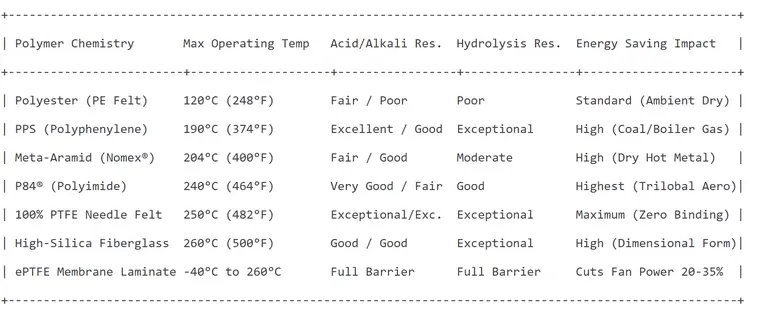
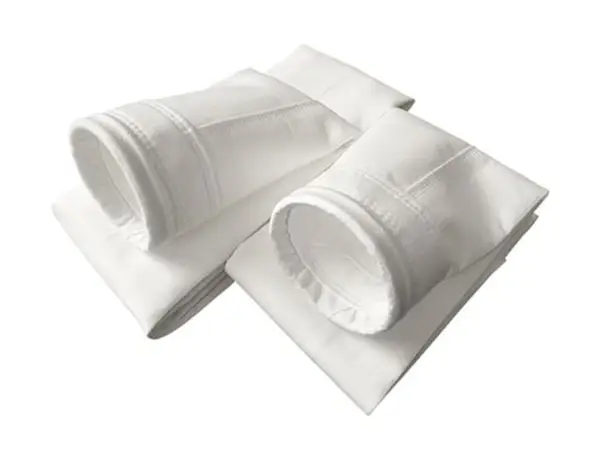
3.1 Polyester (PE) Needle Felt: Economical Ambient Filtration
- Continuous Operating Ceiling: 120°C (248°F) | Peak: 150°C
- Energy Contribution: High tensile strength and abrasion resistance for raw cement grinding, woodworking, grain elevators, and aggregate handling. Standard singed polyester provides baseline mechanical durability. Adding an oleophobic/hydrophobic fluorocarbon finish prevents moisture bridging and cement agglomeration during cold startups, avoiding steep baseline ΔPΔP spikes.
3.2 PPS (Polyphenylene Sulfide / Ryton®): Sulfur & Acid Gas Resistance
- Continuous Operating Ceiling: 160°C – 190°C (320°F – 374°F)
- Energy Contribution: The standard media for coal-fired utility boilers, biomass combustion, and incinerators with high sulfur content (SOxSOx). PPS fibers resist acid hydrolysis where aramid degrades. XINLIAN PPS + PTFE micro-blended felts reduce surface friction, accelerating cake discharge and lowering compressed air consumption.
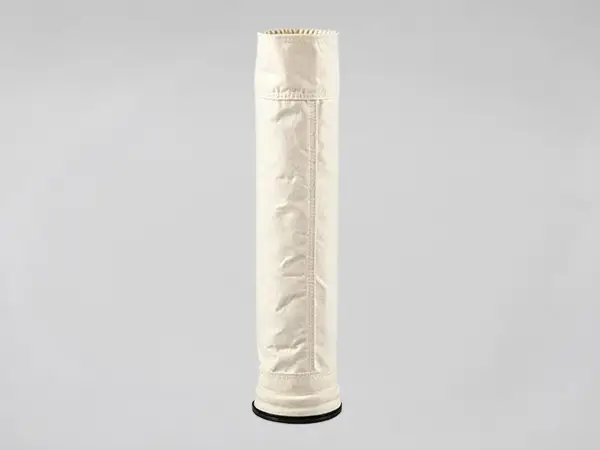
3.3 Meta-Aramid (Nomex®): High-Temperature Dry Mechanical Strength
- Continuous Operating Ceiling: 180°C – 204°C (356°F – 400°F)
- Energy Contribution: Provides excellent dimensional stability and flex-abrasion resistance in hot-mix asphalt plants, foundry cupolas, and electric arc furnace (EAF) fume capture. Because aramid maintains its modulus at 200∘C200∘C, bags resist shrinkage that would otherwise pinch support cages, choke exhaust airflow, and overload fan motors. (Note: Vulnerable to moisture hydrolysis at elevated acid concentrations).
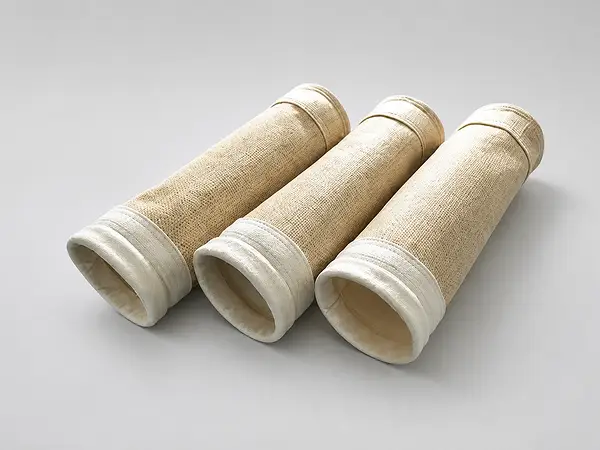
3.4 P84® (Polyimide): Aerodynamic Efficiency via Trilobal Fibers
- Continuous Operating Ceiling: 240°C (464°F) | Peak: 260°C
- Energy Contribution: P84 fibers feature a proprietary tri-lobed (cloverleaf) cross-sectional structure. This geometry provides an 80% higher specific surface area compared to conventional circular synthetic fibers. Sub-micron particulate is captured at the outer surface rather than penetrating the core, maintaining a lower operating pressure drop across the entire 36-month bag lifespan.
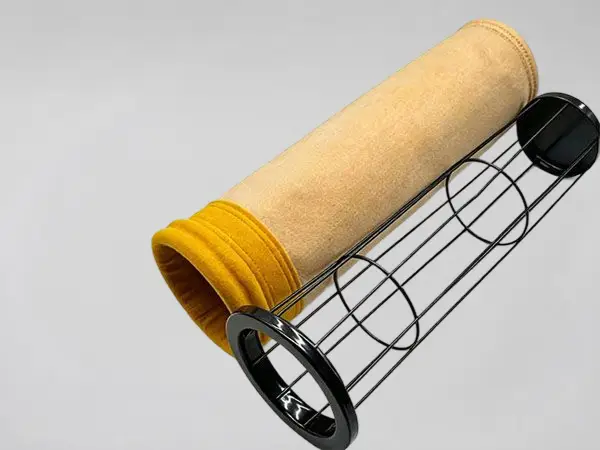
3.5 100% PTFE Needle Felt: The Ultimate Chemical & Release Surface
- Continuous Operating Ceiling: 250°C (482°F) | Peak: 280°C
- Energy Contribution: For severe flue gas conditions—such as hazardous waste incineration, titanium dioxide calcination, and chemical kilns containing aggressive HCl,HFHCl,HF, and nitrogen oxides—100% PTFE fiber needle felt exhibits near-zero surface energy. Particulates detach cleanly at pulse pressures as low as 0.25 MPa0.25 MPa, cutting pulse frequency by over 60% compared to standard high-temperature alternatives.
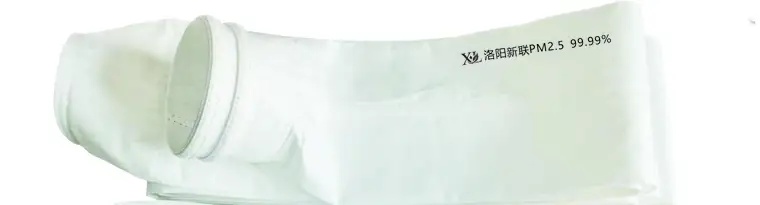
3.6 High-Silica & Modified Glass Fiber: Maximum Dimensional Stability
- Continuous Operating Ceiling: 260°C (500°F) | Peak: 300°C
- Energy Contribution: E-glass and high-silica woven or needle-punched fabrics provide high thermal stability with near-zero thermal elongation. When treated with PTFE acid-resistant chemical dips, these fabrics handle heavy dust loads in cement kiln preheaters and metallurgical smelting while maintaining consistent internal channel dimensions.
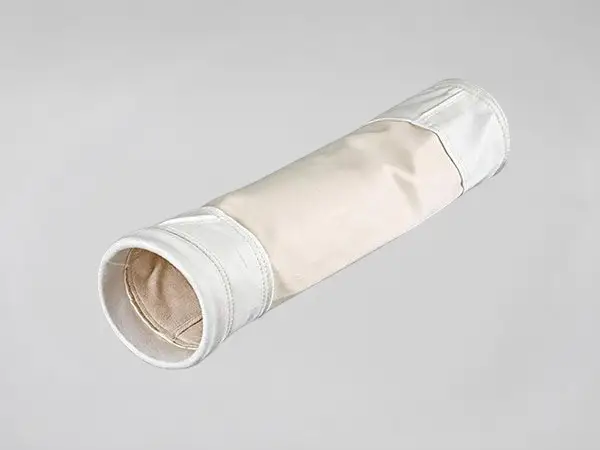
- Depth Filtration vs. ePTFE Surface Filtration: The Paradigm Shift
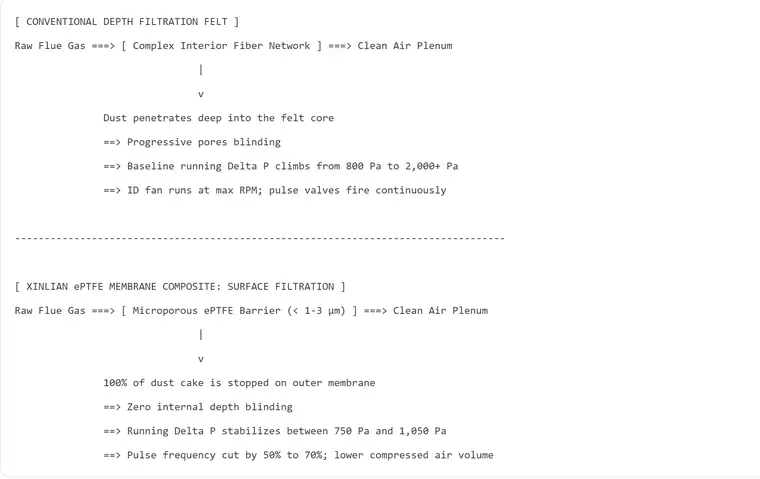
The Physics of ePTFE Membrane Lamination:
- Stabilized Baseline Resistance: By stopping particulate directly at the gas-membrane interface, running differential pressure stabilizes at 750–1,050 Pa750–1,050 Pa, preventing the progressive climb toward 2,000+ Pa2,000+ Pa typical of uncoated fabrics.
- Guaranteed Ultra-Clean Compliance: Thermally bonded ePTFE membranes capture PM2.5PM2.5 and sub-micron particulates at >99.99%>99.99% efficiency, consistently achieving verified emission levels <5 mg/Nm3<5 mg/Nm3.
- Reduced Cleaning Stress on System Components: Clean cake release at lower pulse pressures (0.25–0.30 MPa0.25–0.30 MPa) minimizes structural flex fatigue on filter bags, sewing threads, pulse valves, and air compressors.
5. The XINLIAN Advantage: Full-Chain Engineering from Turnkey Equipment to Core Media
Selecting high-grade filter media will not resolve energy issues if the support cages are corroded or the baghouse plenum suffers from poor aerodynamics.
Unlike intermediary trading companies or single-item workshops, Luoyang Xinlian Environmental Protection Technology Co., Ltd. (XINLIAN) is an integrated equipment and media manufacturer providing complete, factory-direct dust collection solutions.
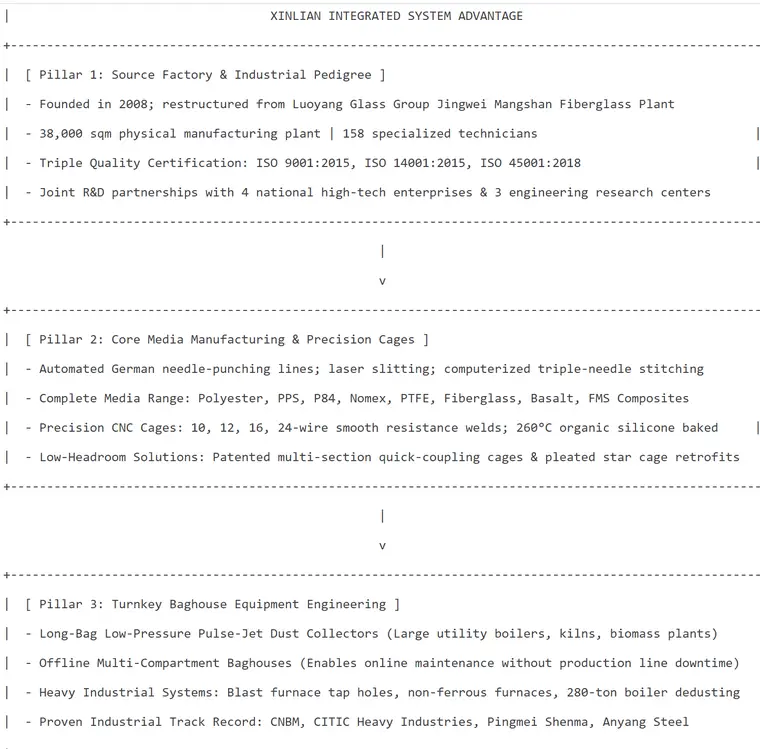
5.1 Factory-Direct Heritage & Scale
Established in 2008, XINLIAN was formed through the restructuring of the Jingwei Mangshan Fiberglass Plant under state-owned Luoyang Glass Group. This heritage provides decades of institutional mastery in high-temperature glass fiber processing, textile engineering, and heavy industrial air filtration.
Operating from a 38,000 square meter manufacturing base with 158 skilled technical professionals, XINLIAN manages automated German needle-punching lines, computerized multi-needle sewing equipment, and CNC resistance cage welders under ISO 9001:2015, ISO 14001:2015, and ISO 45001:2018 quality management systems. Direct factory manufacturing eliminates trading company markups, guarantees batch-to-batch consistency, and delivers reliable export quality.
5.2 Precision-Fabricated Support Cages: Protecting Airflow Dynamics
A common cause of high differential pressure is improper fit between the filter bag and its internal support cage.
- Low-spec cages with only 8 wires allow fabric to collapse excessively, restricting internal flow channels and accelerating mechanical flex wear.
- Weld burrs and misaligned rings puncture bags, creating dust bypass leaks.
- Flaking paint or surface corrosion causes frictional drag that prevents clean pulse expansion.
XINLIAN manufactures precision baghouse filter cages on automated CNC multi-spot resistance welding lines:
- Wire Count Configuration: 10, 12, 16, and 24-wire designs engineered to maintain an open cross-sectional airflow area for bags up to 10 meters long.
- Corrosion Barrier Coatings: High-temperature organic silicone baked finishes (rated for 260°C continuous service in acid gas), heavy hot-dip galvanizing, or electropolished SS304/SS316L.
- Low-Headroom Multi-Section Cages: Quick-connect couplings allow smooth section-by-section installation in buildings with limited overhead clearance without damaging the bag fabric.
- Pleated Star Cages: Allow plants to convert standard cylindrical bags to pleated filters, expanding total filtration surface area by 200% to 300% within the existing collector footprint to reduce face velocity (A/CA/C ratio) and lower operating ΔPΔP.
5.3 Complete Turnkey Baghouse Equipment Engineering
Beyond consumables, XINLIAN designs, manufactures, and commissions complete industrial dust collection installations:
- Long-Bag Low-Pressure Pulse-Jet Baghouses: Handle large-volume industrial flue gas flows with optimized inlet baffles that distribute gas evenly across compartments.
- Offline Multi-Chamber Baghouse Units: Incorporate pneumatic poppet isolation dampers, allowing maintenance teams to take individual compartments offline for bag inspection without shutting down plant production lines.
- Specialized Heavy Industry Systems:
- Blast furnace tap hole and casting yard fume extraction systems.
- Non-ferrous smelting furnace dedusting installations.
- 280-metric-ton utility coal-fired boiler flue gas cleanup systems.
- Concrete and aggregate batching plant pulse-jet dedusting stations.
- Proven Industry Footprint: Trusted partner to China's leading industrial conglomerates, including China National Building Material Group (CNBM), CITIC Heavy Industries, China Pingmei Shenma Group, and Anyang Iron & Steel Group.
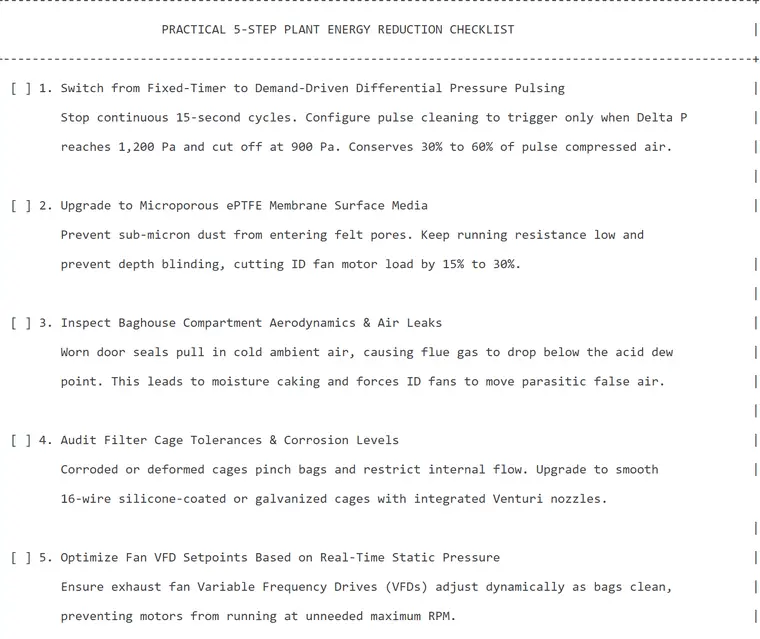
6. Actionable Engineering Checklist: 5 Steps to Cut Baghouse Electricity Bills
To capture immediate energy savings from your dust collection system, follow this practical engineering checklist:
7. Conclusion: Turn Your Industrial Dust Collector into an Energy-Saving Asset
In modern industrial manufacturing, environmental compliance and cost containment are inseparable goals. Your dust collection system should ensure clean air compliance without operating as an uncontrolled drain on plant power.
By selecting engineered filter media matched to your operational chemistry, upgrading to ePTFE surface filtration, and pairing bags with precision-aligned support cages, your plant can:
- Lower running differential pressure (ΔPΔP) by 300–800 Pa300–800 Pa.
- Save tens of thousands of kilowatt-hours in annual ID fan power.
- Cut compressed air pulse frequency by more than 50%.
- Extend average filter bag working life from 12–18 months to 36+ months.
- Maintain emissions compliance with guaranteed performance <5 mg/Nm3<5 mg/Nm3.
Partner with XINLIAN for Factory-Direct Engineering Support
Whether you are retrofitting an existing coal-fired boiler baghouse, troubleshooting high differential pressure in a cement plant, or designing a complete dust control system:
- Official Website: https://www.xlfilterbags.com/
- Manufacturer: Luoyang Xinlian Environmental Protection Technology Co., Ltd.
- Factory Base: Luoyang City, Henan Province, China (38,000 m2m2 Manufacturing Base)
- Direct Technical Consultation: [email protected] | [email protected]
- WhatsApp / Direct Engineer Line: +86 173 3791 2288
XINLIAN — Integrated Industrial Dust Collection Solutions from Fiber to Full-Scale Equipment.